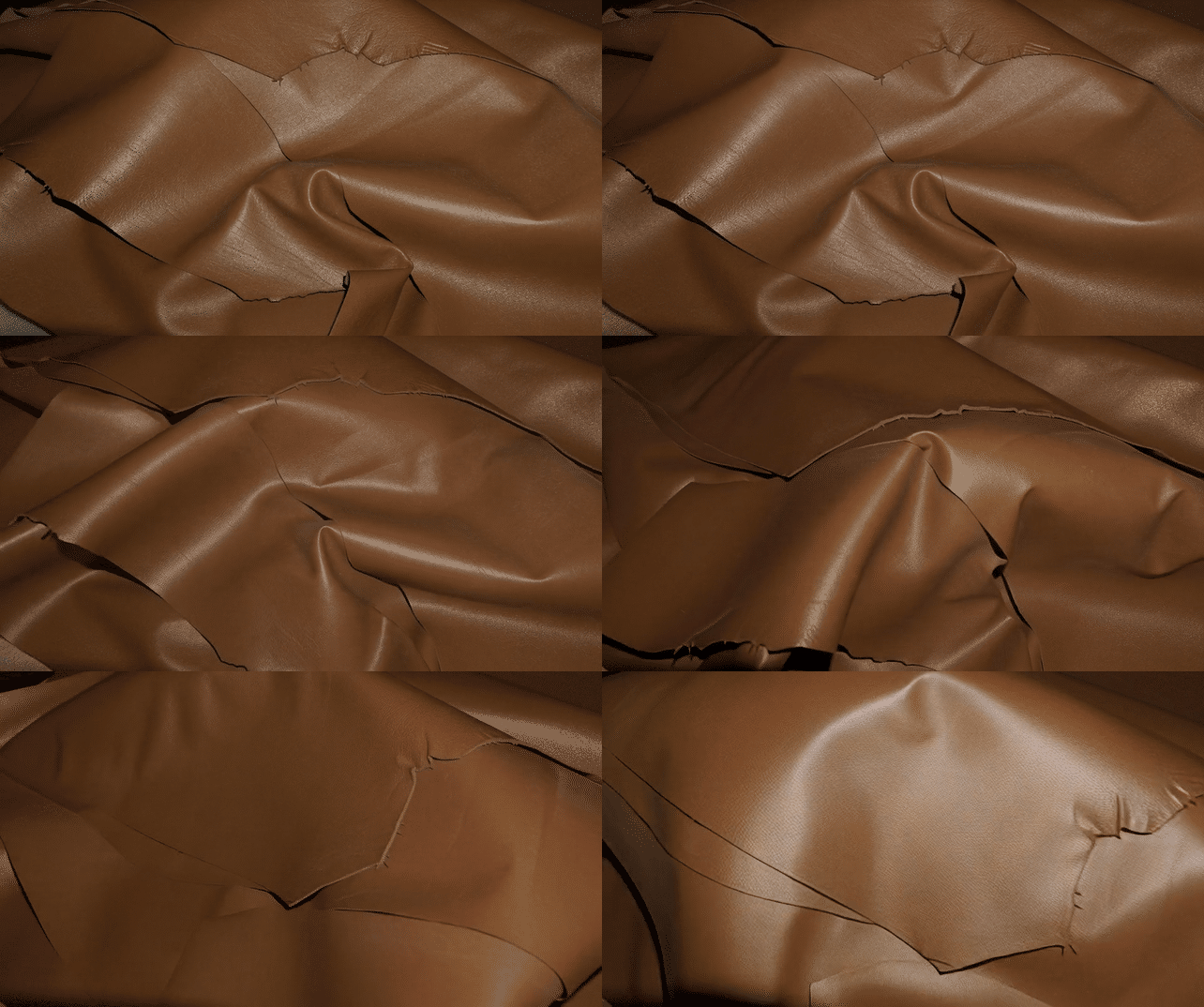
Choosing leather by what you're making: garments, accessories, and footwear
The same hide that drapes beautifully in a jacket will collapse in a structured bag. Here is how to pick by end use.
By Zach Cadwallader, Head of Digital Marketing & Innovation · · 5 min read
Most sourcing conversations start with the animal. Lamb or calf, cow or goat. That's the wrong first question, and it's why designers end up with beautiful leather that fights the pattern.
The hide tells you about grain, size, and price. What the finished piece actually does when someone picks it up comes from two other numbers: weight and temper. Get those right and a surprising range of hides will work. Get them wrong and the best calfskin in the building won't save the sample.
Weight, and what the ounce actually means
In the US, leather thickness is sold by weight in ounces per square foot. One ounce is 1/64 of an inch, or roughly 0.4mm. So 2-3 oz leather runs about 0.8mm to 1.2mm, and 4 oz is about 1.6mm.
Hides get sold in ranges because a hide isn't uniform. It's thinner at the belly and edges, denser through the bend and shoulder, and the tanning and splitting process shifts it further. When you buy 4-5 oz, you're buying an average with real variation inside it.
The rough industry map looks like this. Light leathers in the 1-3 oz band go to linings, garments, and upholstery. The 4-7 oz middle covers bags and wallets. Anything 8-10 oz is belt and holster territory, where you want the material to refuse to bend.
That map is a starting point, not a spec. Two hides at the identical weight can behave nothing alike, which brings up the number nobody prints on the invoice.
Temper is the part you have to touch
Temper is the hand of the leather: how soft or firm it is, how it falls, whether it stands up on its own or puddles. It comes mostly from tannage and the finishing that follows.
Chrome-tanned leather is softer in temper at any given thickness. It drapes, takes color across a wide range, and it's less dense than veg-tan, so for the same thickness and area it weighs less. Vegetable-tanned leather is firm and fibrous. It holds a shape, it burnishes at the edge with water and friction, and it darkens with handling over the years. Combination tannages sit between the two, which is where a lot of good bag leather lives.
Here's the practical version: a 3 oz chrome-tanned lambskin and a 3 oz veg-tanned calf are the same thickness and completely different materials. One becomes a shirt jacket. The other becomes a card case. A spec sheet won't tell you which is in front of you. Your hands will, in about four seconds.
Garments: drape wins
Apparel leather needs to move with a body, fold at the elbow, and hang without breaking into hard creases at the hem.
That pushes you light. Lambskin sits around 0.5mm to 0.8mm and is the softest of the common garment options, with fine fibers and a fast break-in. Calfskin lands nearer 0.8mm to 1.0mm, giving you a defined silhouette without stiffness, which is why it shows up in so many classic jacket patterns. Garment-weight cowhide, around 1.2mm to 1.4mm, is heavier and considerably tougher, and it's the right call for a moto piece where abrasion resistance is the actual requirement.
The trade is real. Lambskin's soft, loosely interwoven fiber structure is what gives it that drape, and it's also why it stretches and tears more easily than cowhide, which carries several times the tensile strength. If your pattern has a load-bearing seam or a hardware anchor, don't put lamb behind it.
Skin size matters more than designers expect on garment runs. Lamb and goat come in small skins, so a coat pattern may take five or six of them, and every additional skin is another chance for a shade or grain break across a panel. Cut a full garment from one lot if you can.
Accessories: body, and the ability to hold a corner
Bags are where the "wrong hide" problem shows up worst. A soft chrome-tanned garment leather in a structured tote gives you a bag that sags at the top line, rolls at the corners, and looks tired on the shelf by week three.
Structured pieces want body, which usually means moving up in weight and firmer in temper. Handbags and thicker wallets commonly land in the 3-4 oz range, with veg-tan or combination tannage doing the work of keeping the shape. Veg-tan is the traditional choice anywhere stiffness is an asset, and it's the reason a well-made card case still snaps shut after five years.
Soft bags flip the whole thing. A slouchy hobo, a drawstring bucket, an unlined pouch: those want the same chrome-tanned suppleness a jacket wants, just in a slightly heavier weight so the panel doesn't feel flimsy in the hand.
So the question isn't "what leather for a bag." It's whether the bag is supposed to stand up by itself. Answer that first and the weight falls out of it.
Footwear: the last decides everything
Shoes are a different engineering problem. Most footwear gets built by stretching the upper over a last and pulling it tight, so the leather has to fall inside a narrow band or it won't last cleanly.
Upper leather generally runs 3-5 oz, about 1.2mm to 2.0mm. Casual footwear tends to sit around 1.4mm to 1.8mm; work boots go heavier, near 2.0mm to 2.2mm. Linings are typically veg-tanned calf in the 2-3 oz range. The stiffeners are their own decision: toe puffs around 2mm to 2.2mm, heel counters closer to 3mm to 3.5mm, both veg-tanned, both skived at the edges so the thickness stays where the shape needs it. A men's leather outsole is around 5mm.
One detail worth stealing from shoemakers no matter what you're building: they orient each pattern piece so the stretch direction of the hide runs in the direction the last will pull. Leather isn't isotropic. It stretches more across the backbone than along it, and where you place the pattern on the hide changes the result as much as which hide you picked.
Order a sample ring first
None of this replaces handling the material. Weight tells you thickness, tannage tells you roughly how it should behave, and neither one tells you how a specific lot falls over a pattern.
Get a sample ring, cut a swatch, fold it the way the garment will fold, or stand a panel up the way the bag has to stand. Ten minutes with samples catches the mistakes that a production run turns expensive.
Frequently asked questions
What leather weight is best for a garment?
Most garment leather falls between 1 and 3 oz, roughly 0.4mm to 1.2mm. Lambskin near 0.5-0.8mm for maximum drape, calfskin near 0.8-1.0mm for a bit more structure, garment cowhide at 1.2-1.4mm when durability outranks softness.
Can I use garment leather for a bag?
Sometimes, if the bag is meant to be soft. For a structured bag, no. Garment leather doesn't have the body to hold a corner or a top line, without proper interfacing.
What's the difference between veg-tanned and chrome-tanned leather for my project?
Veg-tan is firmer and holds shape, so it suits structured bags, small leather goods, belts, and shoe stiffeners. Chrome-tan is softer at the same thickness and drapes, so it suits garments, linings, and soft accessories. Combination tannages give you some of both.